|
Articles
1 • 2 • 3 

3 months Ago
|
| |
The Gulf of Mexico fills with oil. This disaster is short-term insoluble, even for highly-advanced, 21st-century, western nations. Medium- to long-term, there is likely to be a solution. There always is. The cleanup process will be long and painstaking, but it will be out-of-sight for most people. Once the problem is solved and years have passed, the shortness of human memory will serve to help us forget what happened—and to be surprised the next time it happens.
Petroleum is intrinsic to almost all facets of a westerner’s life. It’s the base from which plastics are made, which are essential to our electronic gadgets, our household goods, almost all packaging and countless other goods. It’s used as a base for fertilizers, without which our hapless agricultural system would grind to a halt; the same system uses a tremendous amount of petroleum to harvest this food. It’s also the primary fuel for the transportation system that shuttles cattle, feed and other goods all over the country. Jet fuel needs highly-refined petroleum; the food system as we know it today—far-flung and still tightly integrated enough to deliver perishables from the other side of the globe—would collapse without it. And our high-flying lives with it. And then there are our cars, our personal transportation without which so many Americans could never get to their jobs or their stores or pretty much anything.

The sentiment above is completely understandable when contrasted with the heart-wrenching photos of animals floundering in our mess. To say nothing of the humans that are suffering loss of livelihood and home. It is, however, not enough. We can’t boycott petroleum until we have either (A) another fuel source that is as portable and powerful as refined petroleum or (B) we change our lives significantly to not need so much portable energy.
Choice (A) is a pipe-dream for now. Fusion is the only possible way out—and it’s always 20 years away and it will never be portable (at least not in the short- to medium-term).
That leaves choice (B). We stop depending on food shipped all over the world; we stop pretending that petroleum is cheap; we stop wrapping everything in plastic; we stop disdaining healthy tapwater for individual-sized portions of water wrapped in plastic; we cure ourselves of our deep, deep illness that will continue to kill the planet and produce photos like those above.
So, yeah, hop on a bike if you can; but nothing is solved until we make much deeper changes to our expectations, our lifestyles and, most of all, our ethics.
|
| |

6 months Ago
|
| |
Bill Gates is the world’s most generous philanthropist and has made curing malaria and combating viruses of all kinds his new goal in life (see Mosquitoes, Malaria and Education by Bill Gates (TED) for the video). However, he’s changed his focus to climate change because, though preventing disease is a huge concern for the third world, rampaging climate change will make many more things far worse for the world’s poor. As he put it in his talk, Innovating to zero! by Bill Gates (TED):
“But energy and climate are extremely important to these people, in fact, more important than to anyone else on the planet. The climate getting worse, means that many years their crops won’t grow. There will be too much rain, not enough rain. Things will change in ways that their fragile environment simply can’t support. And that leads to starvation. It leads to uncertainty. It leads to unrest. So, the climate changes will be terrible for them.”
Innovate to Zero! by Bill Gates (TED)
Bill provides a good overview of the effort needed to address climate change as well as pragmatically explaining what it means to do so and what, exactly, such efforts entail. The equation he presents is CO2 = P × S × E × C. P stands for popoulation, which he sees headed to about 9 Billion people from our current 6.8 Billion. He expects that estimate to come down by about 10 or 15 percent “if we do a really great job on new vaccines, health care, reproductive health services”. This does not mean that Bill plans on peddling vaccines that will kill the world’s poor—as has been seriously suggested is his intent on less reliable news sources—but that populations with access to “reproductive health services” and especially societies in which women play a bigger role and have more to say about social life—those tend to have lower birthrates.
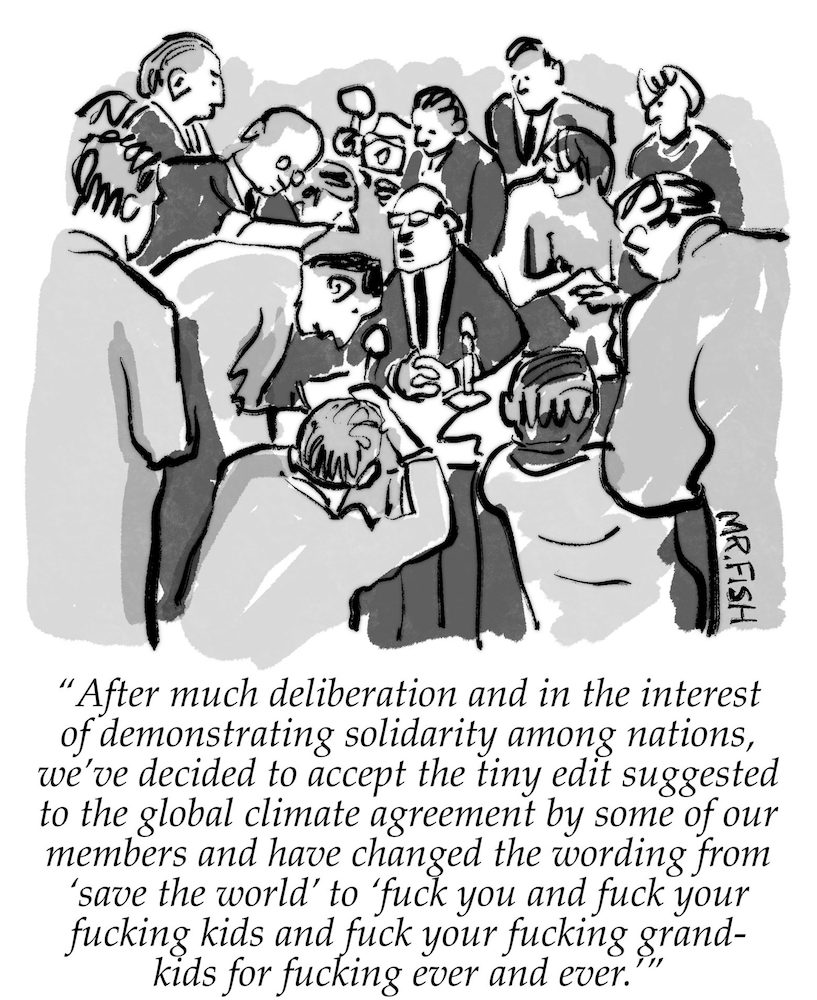
Suggesting that population should be cut even more drastically or by means that are less evolutionary is currently still a no-no. Gates has faith that technology will get us all the energy we need with zero emissions, so the question of how many members of the human race should the planet be expected to house can be safely tabled for another day.
The S stands for services and is somewhat less controversial, as long as he leads by saying that “it’s a great thing for this number to go up” so as not to perturb any capitalists and only suggests that members of the first world “probably could cut back and use less”, but doesn’t require it. It’s the no-sacrifice plan: Keep breeding and using energy as much as you like, ‘cause we’re going to figure out how to get it without further screwing up the planet. You’re welcome.
The E is efficiency, in which an increase is not necessarily a good thing. That is, increasing efficiency doesn’t usually mean that less energy is used overall: Rather, it means that the more efficient service just got cheaper and gets used even more than ever, raising the total energy usage. Again, this is not a problem if you put all your money on the final letter in the equation.
Finally, we have C, which is the amount of CO2 put out for each unit of energy used. This is the one that Gates thinks will go to zero and save us all. It’s kind of the one that has to go to zero because we’re not going to enact any population controls (à la China). We’re also not going to enforce service reductions because once you’ve given people something, you can’t take it away—and once people see other people getting something, they’re all going to want it too (and justifiably so). Even if you’re not going to enforce cuts in lifestyle (services), you could still enforce efficiency standards to make that lifestyle less energy-intensive, but, as mentioned above, an increase in efficiency is likely to be negated by an increase in usage of that service (because it got cheaper).
So, we’re left with hoping that there is some magical fuel source out there that uses no CO2 and is cheap and safe and increases male potency. As Gates puts it, we need energy miracles. Gates goes through the usual suspects—fossil fuels, nuclear and renewables—and points out the weaknesses of each: Fossil fuels are CO2-intensive, nuclear power is complex and expensive and renewables suffer from an energy density & storage problem.
Gates is backing the Terrapower horse:
“The idea of Terrapower is that, instead of burning a part of uranium, the one percent, which is the U235, we decided, let’s burn the 99 percent, the U238. It is kind of a crazy idea. In fact, people had talked about it for a long time, but they could never simulate properly whether it would work or not, and so it’s through the advent of modern supercomputers that now you can simulate and see that, yes, with the right material’s approach, this looks like it would work.”
This sounds quite interesting, as burning a pile of U238 is a much more controllable reaction and coincidentally also burns up most of the waste left over from traditional fission reactors. The pile would basically smolder in the ground for 60 years until it had burned its way through all the fuel. Energy is harvested in the traditional way, with steam generated by the heat of the burning pile driving turbines.
Sure, there’s a lot of work to do, but there are at least a couple of decades in which to do it. Of course, the last Copenhagen conference didn’t go very well and pretty much no country hewed to its required reductions under the Kyoto agreement (5% reduction from 1990 levels by 2012) and the latest financial meltdown has not been met by any real regulatory reform in any country with a big hand in financial markets. And, hey, it only took the U.S. nearly two years to come up with some regulatory reform that will likely die on the floor of the Senate. And it only took over a year to get a gutted corpse of a health care bill to almost be passed—and then only because nearly the whole budget for it will be promised to America’s most important citizens: Corporations. So here’s hoping that Bill and Terrapower can save us from ourselves: Because our governments sure as hell aren’t politically capable of doing it.
|
| |
If you’ve been looking for an introduction to Quantum Computing and how it surpasses our current binary computing, the article A tale of two qubits: how quantum computers work by Joseph B. Altepeter (Ars Technica) is a great place to start. The language is about as accessible as it’s going to get and there are helpful diagrams sprinkled throughout. For example, the engine of a quantum computer—entanglement, and its result: “action at a distance”—is analogized thusly:
“Imagine if someone showed you a pair of coins, claiming that when both were flipped at the same time, one would always come up heads and one would always come up tails, but that which was which would be totally random. What if they claimed that this trick would work instantly, even if the coins were on opposite sides of the Universe.”
Partial and Full DecoherenceThe final two pages delve into the quantum physics and present some of the main concepts—and equations—which is where things get a good deal hairier, if it’s been a long time since you’ve seen notation of this sort. However, any discussion of quantum physics soon blurs the line between hard, measurable physics and philosophy. At some point, the equations abandon us and it becomes very difficult to know what’s going on or even to know what we know about what’s going on or to be able to trust that which we observe or that which our carefully planned experiments observe because even our most careful selves are still influenced by us being ourselves and being constrained by the physical system in which we enjoy degrees of freedom.
Scientists have already reached the point where they are presented with an “equation [that] means that every part of the experiment, even the experimenter, are all part of a single quantum superposition.” (Emphasis in original.) Heisenberg showed long ago that an observation influences that which it observes; in the world of quantum computing, the systems—or superpositions of states—being observed are so delicate and involve such miniscule energies that the measuring instrument exerts an even greater influence because the energy introduced into the system by the act of measurement is disproportionate to the energy of the system itself. The really strange thing is that if, as stated above, the experimenter is part of the superposition, all attempts to follow the chain of superposition to find an end where there is a so-called collapse of the waveform and things are decided one way or the other—à la Schroedinger’s cat—have failed to find it.
The article concludes:
“Maybe, at some point, it all gets too big, and new physics happens. In other words, something beyond quantum mechanics stops the chain of larger and larger entangled states, and this new physics gives rise to our largely classical world. Many physicists much smarter than myself think that this happens. Many physicists much smarter than myself think it doesn’t, and instead imagine the universe as an unfathomably complex, inescapably beautiful symphony of possibility, each superposed reality endlessly pulsing in time to its own energy. To be honest, we just don’t know yet.
“But as far as we’ve looked, it’s turtles all the way down.”
How the hell are you supposed to build a computer based on that? We know how to build 2- and 3-qbit computers, but the 100-qbit computer will likely have to wait until we can answer some of the seemingly unanswerable questions outlined above. As with every generation that looks up toward the next, just before a quantum leap of intuition and reasoning, it seems impossible. But imagine how impossible all that we take for granted today would seem to someone from just a century ago. Maybe humans in just a few generations will take “acting outside of the superposition of reality” for granted and be able to perform the most breathtaking calculations in no time at all. More likely, though, they’ll be taking quantum computing for granted and most will be using it without even knowing it—perhaps to make the Genius mode on their iPods seek out much cooler playlists.
|
| |

7 months Ago
|
| |
Though it sometimes seems that religion always has the upper hand in public debate, there is usually at least one crusader per generation willing to come out strongly in favor of the Enlightenment and against superstition. The article Mencken, Islam, and Political Correctness (Capitalism Magazine) cites the early 20th-century journalist H.L. Mencken on the subject of religion and other closely related superstitions.
“What the World’s contention amounts to, at bottom, is simply the doctrine that a man engaged in combat with superstition should be very polite to superstition. This, I fear, is nonsense. The way to deal with superstition is not to be polite to it, but to tackle it with all arms, and so rout it, cripple it, and make it forever infamous and ridiculous.”
Note that Mencken railed against “superstition” and not just religion. Superstition is that which one believes despite a lack of any supporting evidence or even despite strong evidence to the contrary. Superstition is that which is taken on faith and used as a guiding principle. It is entirely acceptable in a post-Enlightenment world for superstitions—and their supporters—to have to defend themselves on the basis of provable, reproducible facts. It does not suffice to point to a text more than two millenia old and of dubious origin to “prove” that miracles occurred at some point. Even if they did, that they no longer do and seem to be wholly unpredictable in that regard makes them irrelevant as tools in the modern world.
And the only way to go after an idea is to go after its supporters. In the case of religion—and in the specific case of the U.S.—every politician is a supporter. It is, in fact, hard to imagine anyone being elected in the U.S. to a high office with an explicitly non-religious platform. And aspirants would do well to stick to high-falutin’ Christianity, if they want to have any chance whatsoever. But Mencken would not approve of this; why let fools who believe in unprovable fairy tales and superstitions anywhere near the levers that control our society? We wouldn’t let these buffoons anywhere near anything important (like a nuclear power plant, Homer Simpson notwithstanding), so why do we so blithely let them God Bless America their way into office time and again?
Again, Mencken:
“Is [a superstition], perchance, cherished by persons who should know better? Then their folly should be brought out into the light of day, and exhibited there in all its hideousness until they flee from it, hiding their heads in shame. True enough, even a superstitious man has certain inalienable rights. He has a right to harbor and indulge his imbecilities as long as he pleases, provided only he does not try to inflict them upon other men by force.”
Would that that were the case. Instead an airing of their fantastical opinions only seems to strengthen the support they enjoy from their equally fanatical base.
Despite the many counterexamples in modern American politics, Mencken is, factually, right, and the superstition and misinformation to which he refers lurks everywhere…not just in religion. It seems even the most careful of us make assumptions about subjects in which we are not adequately educated. It’s the embodiment of the principle that “a little bit of knowledge is dangerous”: We learn just enough to convince ourselves that we know everything and start espousing opinions based on that knowledge.
As a case in point, the author of the Mencken article himself avers about 2/3 of the way through the article that “[t]here is no pick and choose, or mix and match, no half-doses of belief in Islam, as there is Christendom, as the numerous varieties of faiths and sects in it attest.” This is just a silly thing to believe, regardless of how “numerous” the “varieties of faiths and sects” he interviewed. There is just as much discussion over the true meaning of sections of the Koran—ranging from basic translation to determining whether something was intended as metaphor or literally or whether a particular Sura is considered canon or not—as there are of the Bible. Just because some people interpret the Koran as ordering all believers to kill non-believers (having perhaps, but not necessarily, failed to convert them first) doesn’t mean that a given practicing Muslim actually believes this or is likely to act on it. Certainly no more so than their Christian counterparts are likely to actually believe that their non-Christian friends will end up in hell. It is only our all-too-human love for alienation of the other that lets us believe some obviously preposterous lines of reasoning (or to be swayed by them when employed by others). Most people who identify as Christian probably interpret that whole Judgment Day/Heaven/Hell thing a little more abstractly than their own particular sect dictates. But, the Muslim is the other and so we feel perfectly comfortable ascribing to him an otherworldly discipline—especially when it comes to wishing for all of our deaths.
Richard Dawkins enthusiastically takes up Mencken’s mantle in the 21st-century; in Haiti and the hypocrisy of Christian theology by Richard Dawkins (Washington Post), he discusses Pat Robertson’s putatively horrendous reaction to the earthquake in Haiti (he blamed it on the Haitians having angered the one true God by practicing Voodoo):
“Loathsome as Robertson’s views undoubtedly are, he is the Christian who stands squarely in the Christian tradition. The agonized theodiceans who see suffering as an intractable ‘mystery’, or who ‘see God’ in the help, money and goodwill that is now flooding into Haiti, or (most nauseating of all) who claim to see God ‘suffering on the cross’ in the ruins of Port-au-Prince, those faux-anguished hypocrites are denying the centrepiece of their own theology. It is the obnoxious Pat Robertson who is the true Christian here.”
It is Dawkins at his finest, simply citing the Christians’ own scripture back at them. To which most will scratch their heads and proclaim that they do not believe this, that they instead believe in turning the other cheek and being the Good Samaritan and all that rot. For those, Mr. Dawkins elucidates further, making his point quite crystal-clear:
“Dear modern, enlightened, theologically sophisticated Christian, your entire religion is founded on an obsession with ‘sin’, with punishment and with atonement. […] Educated apologist, how dare you weep Christian tears, when your entire theology is one long celebration of suffering: suffering as payback for ‘sin’ − or suffering as ‘atonement’ for it? You may weep for Haiti where Pat Robertson does not, but at least, in his hick, sub-Palinesque ignorance, he holds up an honest mirror to the ugliness of Christian theology. You are nothing but a whited sepulchre. (Emphasis added.)”
It takes a Dawkins to shake the agnostics out of their rut and remember (realize?) that Christianity does not involve too many sunny moments, actually. Christianity is very firmly about slogging through a sin-encrusted mortal life in the hope that things get better in an unconfirmable beyond. And, with the recent idiocy about the anti-choice commercial aired during the Super Bowl, Dawkins also has something to say about the highly specious reasoning employed to justify not having aborted said Tim. The argument goes something like this: since the mother decided against all logic not to abort her fifth child and, since he grew up to play football really well, all abortions are wrong. Dawkins cites the idiotic faux-syllogism about Beethoven happily bandied about by the anti-choice crowd and then concludes (from the article The Great Tim Tebow Fallacy by Richard Dawkins (Washington Post)):
“If you follow the ‘pro-life’ logic to its conclusion, a fertile woman is guilty of something equivalent to murder every time she refuses an offer of copulation. […] As far as anything that matters is concerned, an aborted fetus has exactly the same mental and moral status as any of the countless trillions of unconceived babies.”
An abortion is just one way of not conceiving a potential genius, though perhaps that’s the reason Catholics are not to spill their seed wastefully (a topic most thoroughly covered by Monty Python in The Meaning of Life with Michael Palin leading off with “The Sperm Song”). Bill Hicks also already covered this ground long ago in his comedy routine. Dawkins is certainly not alone—and should be proud to be in such august company—but he’s one of the few (like Mencken) with enough gravitas to get published in a halfway mainstream newspaper…and thank goodness for that.
|
| |

8 months Ago
|
| |
In search of the world’s hardest language (The Economist) is an interesting read, proposing candidates based on number of sounds, number of genders or genres, number of individual sounds, number of difficult-to-make sounds, number of consonants, consistency of spelling (adherence to consistent phonetic rules) or agglutination (combining of words to express concepts).
So, for example, spelling in French and English are not particularly predictive, so that makes them difficult to write error-free without a lot of practice. While French has two genders for nouns, English has none, which makes it much easier in that regard. None of the major western languages have a lot of sounds, with languages from Eastern Europe, Africa and South America providing languages with many more sounds.
As far as declension goes, English is an absolute godsend, with very little to worry about in that regard, compared to a nightmare like German, which has several generally used cases, each of which has different rules depending on noun gender (three of ‘em: masculine, feminine and neutral) and there are, of course, exceptions. While German is in the witness chair, we’ll also note that genders are pretty much randomly assigned, with very few rules to guide a non-native speaker to the right one. Then there are the many foreign words (Fremdwörter) that are generally neuter … unless they’re not. In some cases, the foreign word is so strongly assimilated that it gets a masculine or feminine gender, sometimes—but not always—taken from the gender of the word in German that it replaced.
The Economist article notes that Tuyuca has a “feature that would make any journalist tremble”, which is a requirement that a verb ending correlate to whether or not the implied speaker of the sentence knows something happened or whether the speaker is positing that it did. German’s got this one too: It’s called the subjunctive. For many common verbs, the subjunctive shares a suffix with the case of other non-subjunctive cases so, when you’re first learning German and you’re reading a newspaper, you keep thinking someone doesn’t know how to write German because they keeping screwing up the cases. Later, when you learn about the subjunctive, you realize that all those times you read something as fact, it was actually an unsubstantiated allegation.
Though Tuyuca gets the prize for hardest language—it has between 50 and 140 noun groups (or genders)—German gives it a run for its money. German is much more common and yet contains a large number of the features that make a language hard to learn and master. The article didn’t even mention different verb forms depending on relationship of the addresser to the addressee. Here, German mercifully has only two (formal and informal), but it adds another layer of complexity to the act of properly conjugating and declining a verb or choosing a pronoun or possessive. The romance languages have this as well, but they’re missing some other tricks that make German so much fun.
Another very interesting article on a language not mentioned in the Economist article above is Why Chinese Is So Damn Hard? by David Moser
“There is truth in this linguistic yarn; Chinese does deserve its reputation for heartbreaking difficulty. Those who undertake to study the language for any other reason than the sheer joy of it will always be frustrated by the abysmal ratio of effort to effect. Those who are actually attracted to the language precisely because of its daunting complexity and difficulty will never be disappointed. Whatever the reason they started, every single person who has undertaken to study Chinese sooner or later asks themselves “Why in the world am I doing this?” Those who can still remember their original goals will wisely abandon the attempt then and there, since nothing could be worth all that tedious struggle. Those who merely say “I’ve come this far – I can’t stop now” will have some chance of succeeding, since they have the kind of mindless doggedness and lack of sensible overall perspective that it takes.”
Another very common language not mentioned in the Economist article is I’m Trying To Learn Arabic (Slate):
“MSA [Modern Standard Arabic] has about the same role in the Arab world that Latin had in medieval Europe: It’s the language of writing, religion, and formal speeches, but it is no one’s native spoken language any more. Arabic has long since become a series of “dialects,” which are actually more like separate languages, as many varieties are mutually incomprehensible. […]
“So, if I go to Egypt or Lebanon in a year, having managed to get some near grip on my classroom language, I will be walking down the street asking people for a bite to eat in something that will sound almost as conversationally inappropriate to them as Shakespearean English would to us.”
|
1 • 2 • 3 
|